The Tech Careers Beyond Coding That Students Can Explore in High School
Many tech roles start with design, data, testing, and organizing instead of code. Students can try four of them with small projects they can finish in a week or two.


A closer look at what four non-coding tech roles involve day to day, and simple ways for students to try them before graduation.
A counselor is meeting with a junior who has just said something she hears every year: "I like technology, but I am not a coding person." The student is quick, organized, good at explaining things to classmates, and the unofficial leader of every group project. She is also, at this moment, closing a door that was never locked.
Nothing about this is a failure of effort or of teaching. Students answer based on the roles they can see, and the roles most visible from a classroom are usually the ones with "programmer" in the title. Students simply do not often get a look at that work.
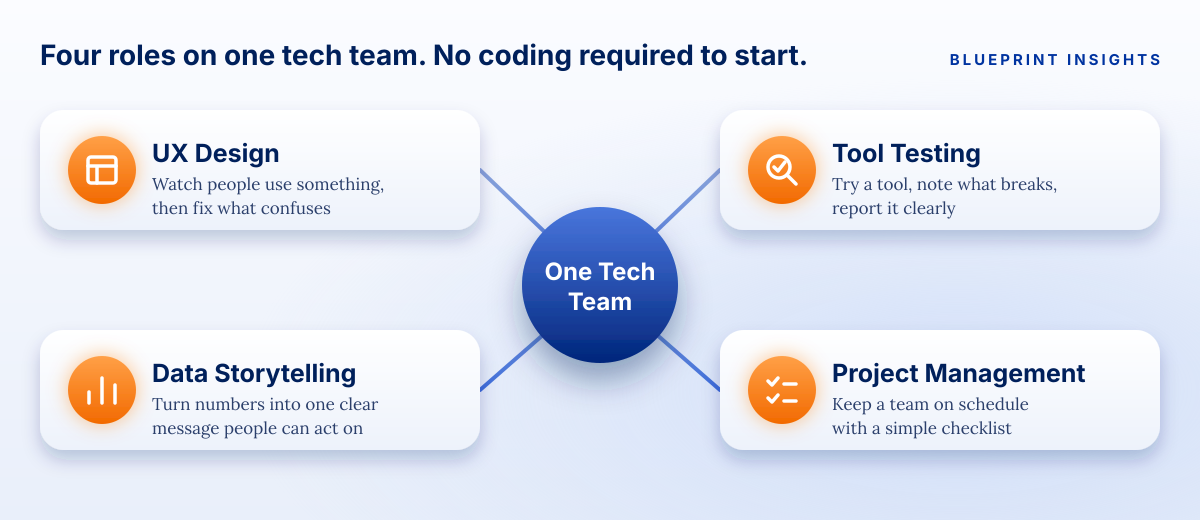
This article is for principals, counselors, and parents who want career exploration to feel open to more students. It describes four roles that sit inside technology teams and do not start with writing code: UX design, data storytelling, tool testing, and project management. For each, it explains what the work looks like day to day and how a student can try it with materials already in a school or at home.
Why does it help to show students more of what tech work looks like?
Because students can only picture careers they have seen. A career exploration conversation tends to name a handful of well-known jobs, and the rest of an industry stays out of view.
The research points in that direction. A 2025 report from YouScience, which drew on aptitude data from 450,000 middle and high school students across all 50 states, found that many students have the aptitudes to do well in high-need fields such as technology, but lack exposure to them. The report was summarized by the California School Boards Association. An aptitude is not a guarantee of fit, but the finding is a useful reminder that visibility comes first.
Students' own words say something similar. In the Walton Family Foundation-Gallup Voices of Gen Z study from May 2025, which surveyed 1,687 students ages 13 to 18, about half said their coursework does not let them do what they do best. That study does not measure career preparation directly, so it is context and not proof. Still, it fits what many counselors observe: students have strengths, and they look for places to use them.
An educator quoted in Education Week in July 2026 made a related point. A career exploration coordinator for the Houston school district said that listening to a list of careers is not the same as seeing yourself in one. That is why the ideas below are all things a student can do, not only read about.
What does a UX designer do, and how can a student try it?
A UX designer works out how a website or app should work for the people who use it. The job is to notice where a person gets confused, then change the design until they do not.
The federal Occupational Outlook Handbook describes digital designers as people who develop, create, and test the layout, functions, and navigation of a website or interface for usability. It lists the median annual wage for web and digital interface designers at $104,000 in May 2025. It also notes that educational requirements for web developers and digital designers range from a high school diploma to a bachelor's degree, depending on the setting. A median describes the whole occupation, not a starting salary.
A student can try this role with one small project:
- Pick a real thing to improve. A school club sign-up page, a lunch menu, or a schedule that is hard to read all work.
- Watch one person use it. Ask a classmate to find something and say aloud what they are thinking. Take notes without helping.
- Sketch a better version on paper. A pencil sketch counts. Then test it on a second person.
What is data storytelling, and where can students practice it?
Data storytelling is the work of turning numbers into a clear message that a person can act on. The analysis finds the pattern. The storytelling explains why it matters, in plain words, to someone who was not there.
The closest federal category is data scientists. The Bureau of Labor Statistics reports a median annual wage of $112,590 for data scientists in May 2024 and projects employment to grow 34 percent from 2024 to 2034, much faster than the average for all occupations. Typical entry-level education is a bachelor's degree. The same handbook lists communication among the important qualities for the role, next to analytical and math skills. Data storytelling is a smaller piece of that larger job, and not every analyst is a data scientist, so treat the figures as a view of the field and not a forecast for any one student.
Students can practice with data they already care about:
- Choose a question. How many students ride the bus? Which lunch line is longest? What do classmates do after school?
- Collect a small set of answers. A short survey of 30 to 50 people is enough.
- Make one chart and one sentence. The chart shows the pattern. The sentence says what a principal or a parent should take from it.
The test of a good data story is simple: can someone read it in thirty seconds and know what to do next?
What is tool testing, and what does it have to do with AI?
Tool testing means using a piece of software on purpose, noticing where it works and where it does not, and reporting what you find clearly. It is a careful, curious kind of job, and it is increasingly relevant as new software tools, including AI tools, arrive in workplaces and schools.
There is no federal job title called "AI tool tester," so we point to the closest match. The Occupational Outlook Handbook describes software quality assurance analysts and testers as people who identify problems with applications or programs and report defects. It lists a median annual wage of $104,300 for that occupation in May 2025 and says a bachelor's degree is typical. Testing an AI tool draws on the same habits: try it, compare results, describe what you saw, and say what should change.
A student can try it this way:
- Pick a tool your school or family already uses. It could be a scheduling app, a learning platform, or an approved assistant.
- Write five tasks someone might do with it. Run each one and record what happened, including anything surprising or wrong.
- Write a short report. What worked, what did not, how to reproduce it, and one suggestion.
Always follow your school's and family's rules about which tools students may use and what information they may enter. A good tester does not share private details to see what happens.
What does a project manager do, and how can students lead a real project?
A project manager keeps a team moving toward a goal: who does what, by when, and what is blocking the work. Many students already do this informally when they run a club event or organize a group assignment.
The Bureau of Labor Statistics describes project management specialists as people who coordinate the budget, schedule, staffing, and other details of a project. The handbook reports a median annual wage of $100,750 in May 2024 and projects employment to grow 6 percent from 2024 to 2034, faster than the average for all occupations. Project managers work in many industries, not only technology, and the role typically calls for a bachelor's degree.
Students can practice with a short, real project:
- Define a clear finish line. "A school open house table" is better than "help out."
- Break it into tasks with owners and dates. A simple shared checklist is enough.
- Hold two short check-ins. What is done, what is stuck, and what changes?
Students who try this learn something no textbook shows: most of the work is communication and follow-through.
Does every one of these roles need a college degree?
Not in every case, but the federal data is candid that bachelor's degrees are typical for most of the roles above. We include that so families have an honest picture. The point of exploring in high school is not to choose a job. It is to learn what work feels like, so that later choices about classes, college, and training are made with more information.
That matters for fairness, too. A 2020 analysis from Brookings Metro found that work-based learning is uneven in availability and quality, and that it matters most for young people who are unlikely to get professional contacts through family. Giving every student a low-cost way to try these roles is one way to widen who gets a look.
What can a school do first?
Start small and build on what is already working. Many schools already have the ingredients: strong teachers, active clubs, and students who are doing real work in class. The step is to make the non-coding side of technology visible and give students a place to try it.
- Name the roles. Add the four roles above to the career exploration materials your school already uses.
- Pair each role with a task. Use the mini projects in this article as a starting menu.
- Ask students to show what they made. A one-page summary with a sketch, chart, or checklist is enough.
- Invite a professional to react. Even a short conversation with someone who does the work helps students see where it leads.
- Capture it. Keep the work somewhere students can find it later.
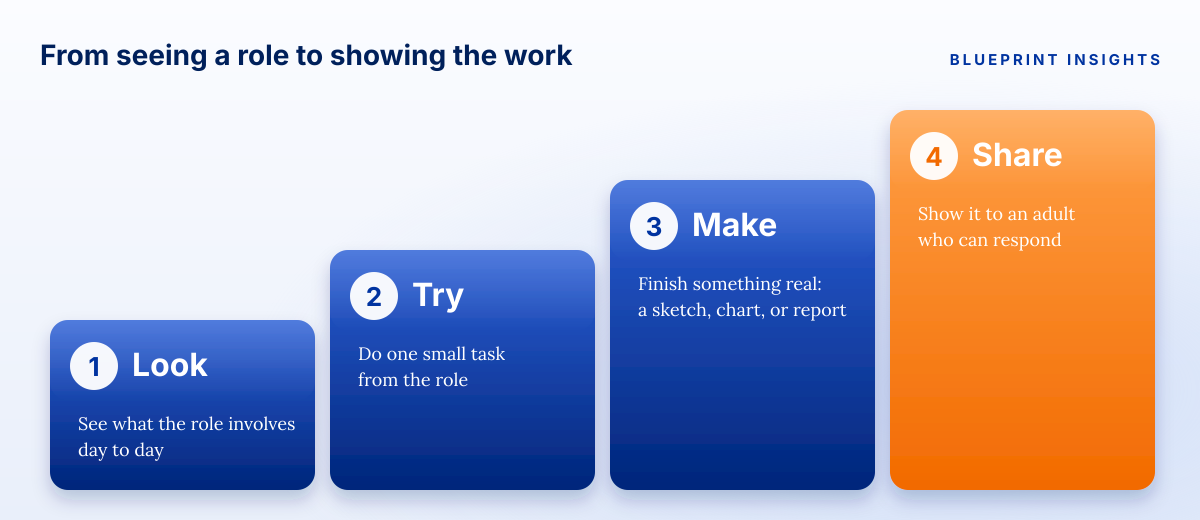
The diagram above shows the path in four steps. A student looks at a role, tries a small task, makes something real, and shares it with someone who can respond.
Our article on where future-ready students build tech workplace skills shows what this can look like in practice.
Where can students try these roles after school?
Some students will want to go further than a classroom project. That is where an after-school program with real practitioners can help. Blueprint Workplace Studio runs on site in the school building, after school, so there is no travel to arrange. Students work on workplace-style projects with industry professionals and finish with work they can talk about.
Blueprint has run this model with students in New York City before, and the Studio is set up to be turn-key for schools that want it. If you are exploring internship-style, future-ready options for your students, we would be glad to talk. Email team@blueprintco.org or visit blueprintco.org/workplace-studio.
A closing thought
The student in the counselor's office does not need to become a coding person. She may already be a designer, a storyteller, a tester, or a project lead who has not yet seen the title. Our job as the adults around her is to show her the door is open and hand her something to try.
Frequently asked questions
What tech careers do not require coding?
Several roles on technology teams start with other skills, including UX design, data storytelling, software testing, and project management. Some of them use technical tools, and some still involve learning basic technical skills over time.
How can high school students explore tech careers without coding?
Try a small project that mirrors the work: improve a real page with a UX sketch, answer a question with a simple chart, test a tool and write a short report, or lead a short project with a checklist.
Do non-coding tech careers pay well?
Federal data shows median annual wages above $100,000 for several related occupations, such as web and digital interface designers, software quality assurance analysts and testers, and project management specialists. Medians describe whole occupations and not starting pay, and most of these roles typically call for a bachelor's degree.
Where can students find these opportunities after school?
Ask your school about clubs, career exploration events, and local programs. Some schools host after-school programs on site that pair students with industry professionals, including Blueprint Workplace Studio.
How can parents support a student who is unsure about tech?
Ask what kinds of problems they enjoy solving, then help them find a small project that matches. Interest grows through trying, so a short, low-pressure first step is enough.
Note: This article shares Blueprint's perspective and general guidance for educational and illustrative purposes. Every organization, program, and regulatory environment is different, so adapt these ideas to fit your context.

Real talk on systems work
Get practical insights on automation strategy, vendor selection, and building systems ready to scale. The kind of advice that saves you thousands and six months of headaches.