The Graduate Job Market Is Tight: How High Schools Can Give Students a Head Start
Entry-level hiring is tight, and employers want proof of skills. Schools can add real projects with real audiences to strong academics so students graduate with stories to tell.

Notes on adding real projects with real audiences to the strong academics schools already offer.
It is a Tuesday in May, and a senior is sitting in the guidance office with a strong transcript, a solid attendance record, and a résumé that lists two clubs and a part-time job. She has applied to a dozen places. She has heard back from two. The counselor across the desk knows she is capable. The question is how to help her show it.
This is a hard moment to be a young job seeker, and it is a hard moment to be the adult helping one. The good news is that schools already do the difficult part, which is building knowledge and character. What is often missing is a way for students to show those strengths in the form hiring teams are asking for. This article lays out what the data says about the entry-level market, what employers say they look for, and how principals and district career readiness leads can add real-world practice alongside the strong academics already in place.

Why Is the Graduate Job Market So Tight Right Now?
It is tight because fewer entry-level doors are opening at once. The Federal Reserve Bank of New York tracks unemployment for recent college graduates ages 22 to 27. As reported by Entrepreneur, that rate rose to about 5.6 percent by late 2025, the highest in three years, and it now sits above the overall rate of about 4.2 percent. Local reporting on the first quarter of 2026 put the figure at 5.7 percent, against a national rate of 4.3 percent.
Context matters here. The same reporting notes that the rate for recent graduates is still lower than the rate for all young workers, and that young people with degrees remain more likely to be employed and to earn more. A degree still helps. The gap has simply narrowed, so the first job takes more effort to land than it used to.
Employer plans point the same way. The National Association of Colleges and Employers (NACE) reports that employers projected just a 1.6 percent increase in hiring for the Class of 2026 compared with the Class of 2025, which it describes as a flat market. A flat market rewards candidates who can show evidence, not only potential.
For a high school, this is not a reason to worry. It is a reason to be deliberate. Students who start building proof of their skills early arrive at that first application with something to point to.
What Are Employers Asking Graduates to Show?
They are asking for evidence of skills, not only grades. NACE's Job Outlook 2026 survey, which gathered responses from 183 employers in August and September 2025, found that 70 percent now use skills-based hiring for entry-level roles, up from 65 percent the year before. NACE's student survey adds a wrinkle: fewer than 40 percent of graduating seniors said they were familiar with the term.
The advice employers gave in that research is practical. They want students to share examples of times they used their skills to solve problems, to gain experience through internships or work, and to describe what they learned in class and extracurricular activities in terms of skills. NACE also notes that when two candidates are equally qualified, employers overwhelmingly choose the one with internship experience.
Notice what that implies. Students are not being asked to learn something different. They are being asked to be able to tell a specific story about something they did. That is a skill a school can help them build, and it is one that grows with practice.
Two cautions keep this honest. NACE surveys its employer members, so the sample is not every employer in the country. And these findings describe college graduate hiring. They are a helpful signal for high schools preparing students for work, college, or both, not a rule for every pathway.
How Prepared Do Students Feel, and What Is the Experience Gap?
Students feel more prepared than they did a year ago, and many still want more practice. The 2025 Walton Family Foundation-Gallup student survey, fielded in May 2025 with 1,687 students in grades 6 through 12, found that 57 percent of high school students felt prepared for the future, up 11 points from 2024. Half agreed that school lets them do what they do best, up from 40 percent in 2023. Those are encouraging trends, and they speak well of the work schools are doing.
The same research family also shows room to grow. A separate Gallup, Jobs for the Future, and Walton Family Foundation survey found that fewer than 30 percent of high school students feel "very prepared" to pursue any of the postsecondary pathways they are considering. One study cannot say whether students feel prepared because of their coursework or because of something else, and the Gallup student survey does not measure career preparation directly, so treat these numbers as signals and not a verdict.
Then there is experience. A report from the Organisation for Economic Co-operation and Development (OECD), summarized by The 74, found that only 35 percent of students reported attending a job fair and 45 percent reported visiting a workplace. It also found that U.S. students lag other surveyed countries in activities like internships and job shadowing. The author of that piece calls this the experience gap: too few young people take part in work-based activities that connect learning to the world of work.
What Does a Real Project With a Real Audience Look Like?
It is work that someone outside the classroom will actually use. The test is simple: does a person other than the teacher read, use, or respond to what the student made? When the answer is yes, a few things change. The student cares about the details, because someone is counting on them. The student has to meet a deadline that is not only a grade. And the student walks away with a result they can describe.
Here is how that differs from a typical assignment:
- Typical assignment: Write a report about local public transit. The audience is the teacher. The result is a grade.
- Real project: Survey 40 riders at one bus stop, summarize the results in a one-page brief, and present it to the school's transportation coordinator. The audience is a decision maker. The result is a brief that was used.
Both teach research and writing. The second also teaches teamwork, communication, and follow-through, and it leaves the student with a story that begins with "I was asked to," continues with "I did," and ends with "here is what happened." That is the structure employers describe when they ask for examples.
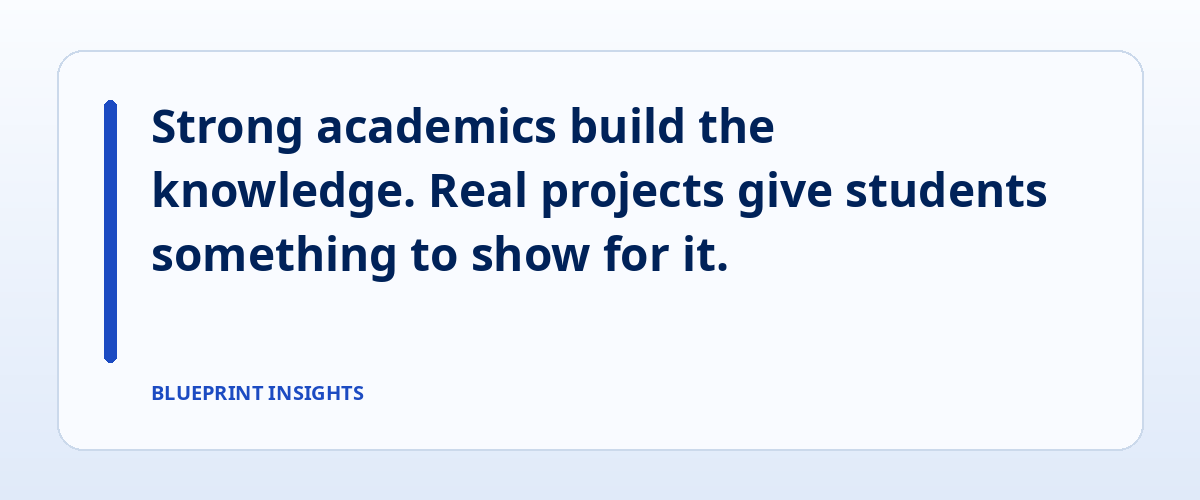
Nothing about this asks a school to lower its academic standards. The knowledge comes first. The task is where students put it to use.
What Can a School Add Without Rebuilding the Schedule?
Start small and attach the work to something that already exists. Five approaches fit most schools:
- Client-style projects. A local organization, a district office, or a school department brings one real question. A student team works on it for 4 to 6 weeks and presents a recommendation.
- Student-run services. Students run a help desk, a data team, a communications team, or an events crew. They take real requests and track real turnaround.
- Job shadows and workplace visits. A half day with a professional, followed by a short write-up in the student's own words.
- Short professional mentorships. Four conversations over a semester with someone in a field the student is curious about.
- After-school programs. Programs that run inside the school building, such as Blueprint Workplace Studio, let students practice workplace tasks in a familiar, safe setting without changing the school day.
Two principles keep these manageable. First, give every task a clear owner on the school side, so that it does not depend on one enthusiastic teacher. Second, keep each project short and finish it. A small project completed is worth more than an ambitious one that fades by midterms.
How Does the Work Become Something a Student Can Show?
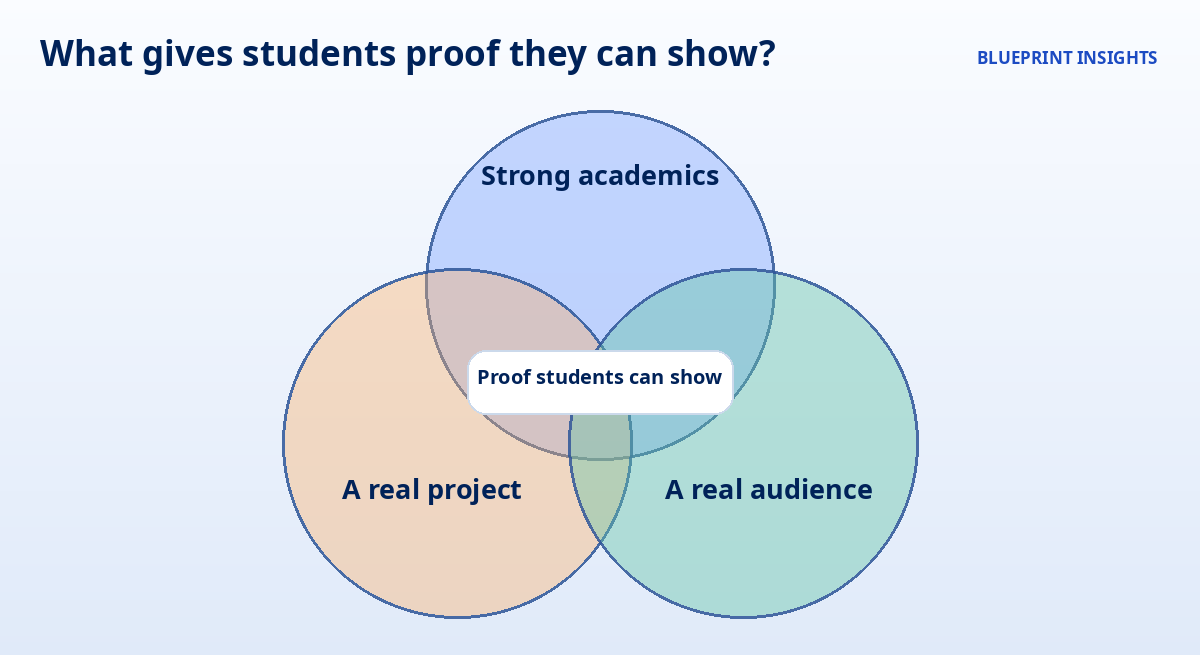
It becomes proof when the student captures and explains it. Doing the task is half the value. The other half is turning it into something an employer or admissions reader can see, and into words the student can say out loud.
Give each student a simple record for every project, with four short parts:
- The situation. Who needed what, and why it mattered.
- The task. What the student was responsible for.
- The action. What the student did, with specifics.
- The result. What happened, with a number or a quote if possible.
This is the same structure career centers teach for interviews, and it lines up with what NACE employers described: examples of using skills to solve problems. A student who has written four of these by graduation is ready for a skills-based conversation. They also have something concrete for a college essay, a scholarship application, or a first interview.
Add one habit that costs nothing: ask students to name the skill in plain words. "I led a team of three" is communication and leadership. "I cleaned and summarized survey data" is analysis. Naming it helps students recognize what they already do well.
Where Do Community Partners Fit?
They supply the real audience, and most are glad to help when the ask is small and specific. A local nonprofit, a city office, a local employer, a hospital, or an alumni network can each offer one question, one hour of feedback, or one workplace visit. School and district teams do not need a long list of partners. Three reliable ones are enough to start.
A few habits make partnerships easier to sustain:
- Ask for something specific and finite. "Review five student recommendations on November 20" is easier to say yes to than "mentor our students."
- Prepare the partner. Share the students' grade level, the time they have, and what a useful comment sounds like.
- Close the loop. Send a thank-you with a sentence on what the students learned. Partners return when they see the effect.
How Will You Know It Is Working?
Track a few simple measures, and review them each term. Avoid counting only participation. Count what students produce and what they say about it.
- How many students completed at least one real project this term?
- How many outside people gave feedback on student work?
- How many students can describe one project using the situation, task, action, and result structure?
- How do students rate their own confidence about a first application or interview, before and after?
A one-page summary each term is enough to show a superintendent, a board, or a funder what is happening, and it tells you where to adjust.
Where Should a School Start?
Start with one grade, one project, and one partner. A simple order works for most schools.
- Pick one group of students. Seniors and juniors are natural choices, since the first applications are close.
- Choose one real question. Ask a partner for a problem that fits in 4 to 6 weeks.
- Name one adult owner. Decide who schedules, who supports students, and who talks to the partner.
- Set up the four-part record. Hand students the situation, task, action, and result template on day one.
- Hold a short showcase. Invite the partner, families, and a district leader to see the results.
- Review and repeat. Note what worked, trim what did not, and add a second project.
A Closing Thought
A tight job market is not a judgment on students or on schools. It is a reminder that evidence matters, and that evidence can be built. Strong academics give students the knowledge. Real projects with real audiences give them the proof. The senior in the guidance office does not need a different education. She needs one more thing to put on the table when someone asks, "Tell me about a time you solved a problem." Give her that, and she will be ready to answer.
Frequently Asked Questions
How can high schools prepare students for a tough entry-level job market?
Add real projects with real audiences alongside strong academics, such as client-style projects, job shadows, and short mentorships. Help students record each one in terms of the situation, task, action, and result.
What is skills-based hiring, and why does it matter for students?
It is a hiring approach that looks at what candidates can do, not only their grades or degree. NACE reports that 70 percent of employers in its 2026 survey use it for entry-level roles, so students benefit from examples of skills they have used.
What counts as a real-world project for a high school student?
It is work that someone beyond the teacher will read, use, or respond to, such as a brief for a school department, a data summary for a local organization, or a service run by students.
How can schools find community partners for student projects?
Start with organizations that already know the school, such as alumni, local nonprofits, city offices, and nearby employers. Ask each for one specific, short task or one hour of feedback.
How do you measure whether career readiness work is helping?
Track how many students complete a real project, how many outside people give feedback, how many students can describe a project clearly, and how students rate their own confidence before and after.
Note: This article shares Blueprint's perspective and general guidance for educational and illustrative purposes. Every organization, program, and regulatory environment is different, so adapt these ideas to fit your context.

Real talk on systems work
Get practical insights on automation strategy, vendor selection, and building systems ready to scale. The kind of advice that saves you thousands and six months of headaches.