Impact Reports Without the Spreadsheet Scramble
Funder reports take weeks when records are separate and definitions are loose. Give every participant one ID, write down your definitions, tag costs to grants, and build each report from the same record.


Notes on getting program, participant, and finance records to agree, written for teams who report to funders and are busy in the middle of a grant year.
It is the second week of the month, and the funder's report is due on the 30th. The program manager has attendance sheets from 3 sites. The finance lead has an expense export that does not say which grant paid for what. The development director has a list of participants from the intake forms, with some names spelled two ways. Everyone is willing to help. Nobody is sure which number is the real one.
So the work begins, and it is the same work as last quarter. Someone copies figures into a template. Someone else asks how "participants served" was counted. A number gets changed at the last minute, and then it no longer matches the version sent to the board. By the time the report goes out, the team has spent more hours cleaning data than learning from it.
This article is for people who carry that load. It explains why funder reporting takes so long, what a connected record looks like in plain terms, and how to build one in small steps without replacing everything you use today.
Why Does Funder Reporting Take Weeks?
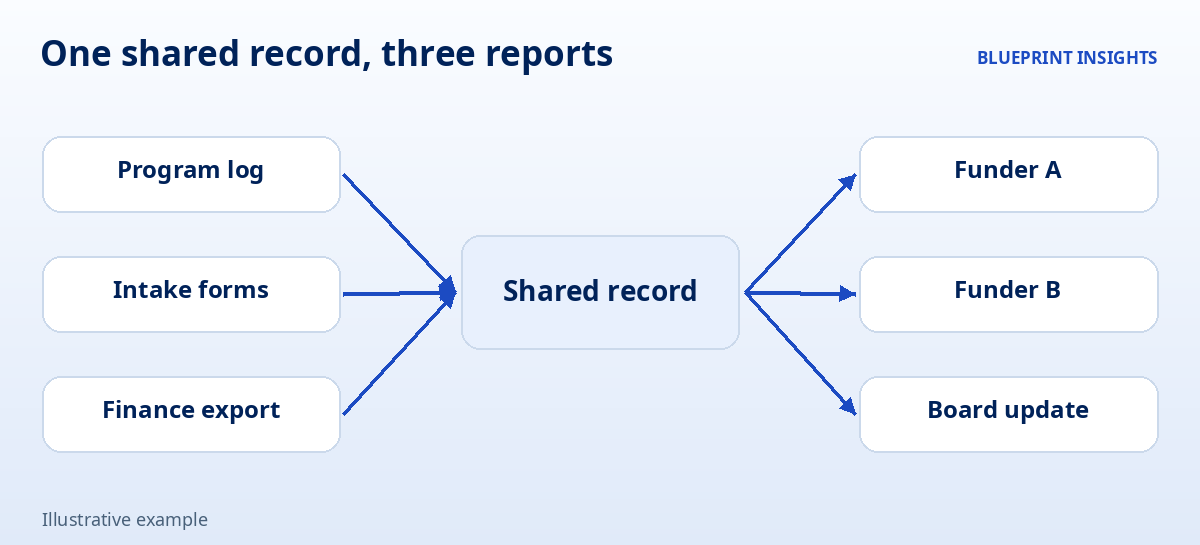
It takes weeks because the facts live in different places and nobody agreed on what they mean. Program staff record who showed up. Intake forms record who enrolled. Finance records what was spent. Each record is accurate for its own purpose, but a funder asks questions that cut across all three: how many people completed the program, and what did it cost per person?
Four patterns cause most of the delay:
- Separate records. The same participant appears in an intake form, an attendance log, and a survey, with no shared ID tying them together.
- Loose definitions. "Served," "enrolled," and "completed" mean different things to different people, and sometimes to different funders.
- Costs that are not tagged. Spending is recorded by category, so assigning it to a specific grant happens by hand at the end.
- One report per funder. Each funder asks for its own format, so the same facts are reshaped again and again.
The pressure behind this is real. In the Nonprofit Finance Fund's 2025 State of the Nonprofit Sector Survey, 36 percent of 2,206 responding organizations ended 2024 with an operating deficit, the highest share in the survey's 10 years, and 52 percent had 3 months or less of cash. The survey used a convenience sample, so treat the figures as a signal about the sector and not a precise measure. Still, when margins are that thin, hours spent reformatting data are hours that cannot go elsewhere.
Funders are also changing how they ask. The Center for Effective Philanthropy (CEP) reported in July 2024 that, across 61 funders whose grantees were surveyed before and after the pandemic, grantees were spending less time on reporting and applications. A CEP series from November 2025 adds a caution: some funders want lighter reporting but lack the tools, training, and technology to support it. Lighter asks are welcome, but they are uneven. A reliable internal record protects you either way.
What Does One Source of Truth Mean for Program Data?
It means one agreed record for each participant, each program, and each grant, with plain definitions that everyone uses. It does not mean one giant system or a single tool. It means that a number is entered once, defined once, and reused wherever it is needed.
A useful way to picture it is a chain. A participant enrolls through an intake form. Staff record services and attendance against that same participant. Surveys and outcomes attach to the same participant. Costs attach to the program and the grant that paid for them. When a funder asks a question, the answer comes from following the chain, not from reconciling four lists.
Many teams already collect most of this. What is missing is the connective tissue: a shared ID, shared definitions, and grant tags on costs. That is why this work is often smaller than it sounds.
What Are the Four Connections That Remove the Scramble?
Four connections do most of the work. You can build them one at a time.
- One ID per participant. Create the ID at intake and use it everywhere: attendance, services, surveys, and outcomes. This ends the "Smith, Jo" and "Jo Smith" problem and makes unduplicated counts possible.
- One page of definitions. Write down what "enrolled," "active," "completed," and "served" mean for your programs, who decides, and when each status changes. This page is often called a data dictionary, and it is the cheapest fix on the list.
- Grant tags on activity and cost. When a service is delivered or an expense is recorded, tag the grant or funding source at that moment. Splitting costs by grant at report time is where many errors begin.
- Reports built from the record. Create each funder's report as a view of the same data, not a separate file that people fill in by hand. When the record is correct, every report is correct.
Notice the order. The ID and the definitions come first because without them, tagging and reporting just move the confusion around.
How Do You Handle Different Funder Formats?
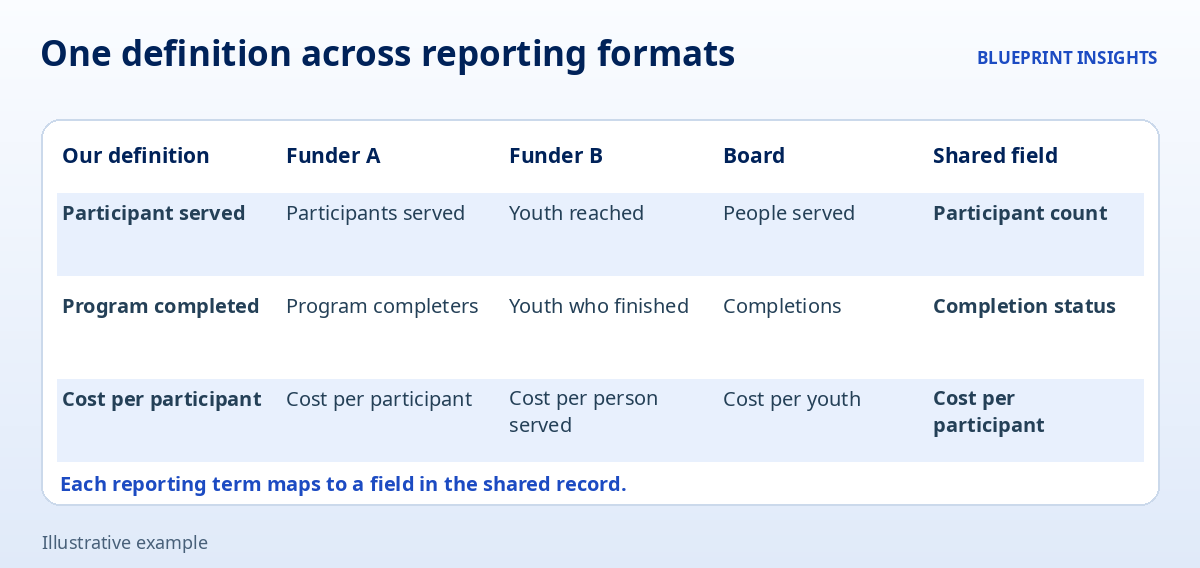
Map each funder's wording to your own definitions once, then reuse the map. This is sometimes called a crosswalk. One funder may ask for "unduplicated individuals served," another for "enrolled youth," and your board may want "active participants." If your own definition is clear, each of those phrases points to a specific field and a specific rule.
Build the crosswalk the first time you answer a funder's questions, and keep it with the definitions page. The next time that funder asks, or a new funder arrives with a similar template, most of the thinking is already done. If a funder's definition truly differs from yours, such as a different age range or a different completion threshold, record that difference in the crosswalk so the exception is visible and nobody has to rediscover it.
What Does This Look Like for One Program?
Here is an illustrative example, not a client story. Imagine an after-school program with 3 sites and 2 funders. Funder A asks for the number of unduplicated youth who completed at least 20 sessions. Funder B asks for cost per enrolled youth. The board wants a one-page update each quarter.
Before connecting anything, the program manager counts completions from site attendance sheets, and the finance lead divides total spending by a headcount from a different list. The two answers disagree, and 2 weeks go to finding out why. After connecting the basics, every youth has one ID from intake onward. "Completed" is defined once as 20 or more sessions. Each session and each expense carries a grant tag. Now Funder A's number is a count of IDs that meet the rule, Funder B's number is grant-tagged cost divided by enrolled IDs, and the board page is built from the same two figures.
Nothing about the program changed. What changed is that the questions can be answered from the same record, and the answers agree.
How Do You Protect Participant Privacy While Connecting Data?
Connect only what the reports need, and control who can see it. Connecting records makes them more useful, and it also makes them more sensitive, because more information sits in one place. CEP's November 2025 series notes that data collected from communities can carry safety risks in the current climate, and it stresses documentation guardrails such as consent templates and safe storage. Those points were made about funders, and they apply just as well to the teams that hold the data first.
A short checklist helps:
- Collect the minimum. If no funder or program decision needs a field, do not collect it.
- Limit access by role. Program staff, finance, and leadership rarely need to see the same fields.
- Record consent. Note what participants agreed to share, with whom, and when.
- Share summaries, not rosters. Reports usually need counts and outcomes, not names.
- Set a retention rule. Decide how long identifiable records are kept, and follow it.
Your legal, funder, and contract requirements will differ, so confirm the details with your own counsel and agreements.
How Do You Start Without Taking On a Big Project?
Start with one report and trace every number in it back to where it came from. This is a small, useful exercise, and it shows you where the chain is broken. Here is a plan that fits into about 6 weeks of part-time effort:
- Week 1: Pick one funder report. Choose the one that hurts most. List every number it asks for.
- Week 2: Trace each number. For each one, write down who produces it, where it is stored, and how it is calculated. Mark any number that someone has to guess or recalculate.
- Weeks 3 and 4: Fix the top 3 gaps. Usually that means writing the definitions page, creating a shared participant ID, and adding a grant tag to costs going forward.
- Week 5: Test with real data. Rebuild last quarter's report from the connected record and compare it to what you sent. Note every difference and explain it.
- Week 6: Add a monthly check. Once a month, look for missing IDs, unmatched costs, and out-of-range dates. Fix problems while they are small.
The monthly check matters most.
What Does a Good Report Day Look Like?
It looks like review, not repair. The numbers are already in place because they were checked all month. The program manager spends the afternoon on the story: what changed for participants, what surprised the team, what the next quarter should look like. The finance lead confirms that costs match grants. Someone reads the final draft against the same record the board sees.
That shift matters because reporting is meant to teach as well as satisfy. CEP's November 2025 series points out that learning rarely makes it back to the people who supplied the information, and that adds to the burden. A team with clean data has time to close that loop, starting with its own staff and participants.
It also changes the conversation with funders. When you can answer a follow-up question in minutes, you can talk about results instead of apologizing for delays. That builds trust over time, which is hard to get any other way.
A Closing Thought
Funder reports are not going away, and most of the work in them is not hard. It is just repeated, scattered, and rushed. A shared ID, a page of definitions, and a grant tag on costs will not make reporting effortless, but they will make it predictable. And a predictable report day gives a team room for the part that matters most: telling the truth about the difference its work made.
Frequently Asked Questions
Why does funder reporting take so long?
The data usually lives in separate records with no shared participant ID and no agreed definitions. Staff then reconcile counts and split costs by grant by hand, and reformat the same facts for each funder.
What is a single source of truth for program data?
It is one agreed record for each participant, program, and grant, with shared definitions. Numbers are entered once and reused, so every report draws from the same facts.
Do we need new software to connect program and finance data?
Not always. Start with a shared participant ID, a page of definitions, and grant tags on costs. Those steps work in most systems, and they show you whether a new tool is needed.
How do we report to funders who each want a different format?
Map each funder's wording to your own definitions once, in a simple crosswalk. Then build each report as a view of the same record, and note any places where a funder's definition differs from yours.
Note: This article shares Blueprint's perspective and general guidance for educational and illustrative purposes. Every organization, program, and regulatory environment is different, so adapt these ideas to fit your context.

Real talk on systems work
Get practical insights on automation strategy, vendor selection, and building systems ready to scale. The kind of advice that saves you thousands and six months of headaches.