Five (5) Checklists for Multi-Site Program Oversight
Year end does not have to be a scramble. Five short checklists for agreements, deliverables, spending, site check-ins, and evidence let you track multi-site work as it happens.


Notes on keeping track of deliverables across many sites as the work happens, written for leaders who would rather not spend year end chasing paperwork.
It is early December, and a program director is trying to answer a fair question from the board: did every site deliver what it promised this year? The answer matters. It shapes how much the board trusts the numbers in front of it, and it can shape the conversation about next year's funding.
There are 9 sites now, grown from 3 last year. Two (2) sent their reports on time. One (1) sent them twice, with different numbers. Another had a site coordinator who left three months ago, and nobody is sure where the attendance records went. The director starts what every leader in this position starts: a round of emails that begins with "quick question." Deep down there are deep breaths and a wondering: how did we get here, again? There must be an easier way.
Nothing here is a failure of effort. The sites are busy doing the work, and the paperwork trails behind it. When oversight is something you lean into once or twice a year, the finish line becomes the start of a new reconstruction project.
This article offers a simpler way. It lays out five short checklists that grantmakers, program directors, and leaders who oversee deliverables across several sites or regions can use to track progress as it happens. Each one has a single job, a single owner, and a rhythm, so the record builds itself while the work is underway.
Why does year end turn into a scramble?
Year end becomes a scramble because the proof of the work is created at different times, by different people, in different places, and nobody is responsible for gathering it until a deadline arrives. Each site holds a piece. The full picture exists only after someone assembles it by hand.
Oversight gaps are common enough to show up in government audits. In its March 2025 review, the U.S. Government Accountability Office analyzed 3,680 single audit findings from 2022 to 2024 addressed to recipients that pass federal funds through to other entities. GAO reported that 36 percent of those findings were primarily tied to three topics: incomplete subaward reporting, subrecipient monitoring activities, and verifying or justifying eligibility decisions. The Congressional Research Service summarized the same finding in March 2026.
That data covers federal pass-through funding, so it speaks most directly to organizations that distribute those dollars. If your funding is private or local, the rules differ, but the lesson travels: when monitoring happens late or informally, gaps show up late and informally too. In our view, the fix is rarely more effort at year end. It is a lighter habit all year.
What should a simple oversight framework include?
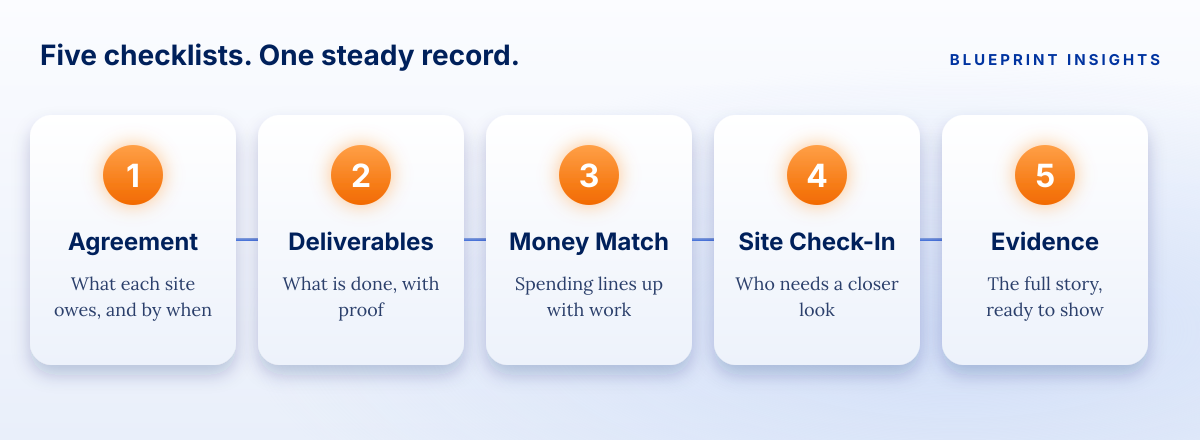
A simple framework includes five checklists, each answering one question, and a calendar that says when each one gets used. Keep every checklist to a single page. If a checklist needs two pages, it is really two checklists.
- Agreement checklist: What does each site owe, and by when?
- Deliverables checklist: What has been delivered, and where is the proof?
- Money match checklist: Does the spending line up with the work?
- Site check-in checklist: Which sites need a closer look, and what did we learn?
- Evidence checklist: Could we show someone the full story tomorrow?
Three ground rules make them work. Give each checklist one owner. Use the same format at every site, so comparing sites does not require translating them. And record things when they happen, not when someone asks.
Checklist 1: What does each site owe, and by when?
The agreement checklist turns each site's commitments into a short, shared list, so nobody has to dig through a contract to learn what is due. Build it once at the start of the year and review it whenever terms change.
- Deliverables named in plain words. What the site will produce, serve, or report.
- Dates for every report and milestone. Put them on one calendar, not in separate contracts.
- Budget by category. What was approved, so spending can be compared against it later.
- Required approvals. Changes to scope or budget that need sign-off before they happen.
- A named contact and a backup. The coordinator who left in August is why this line exists.
When the list is short and visible, sites know what to expect, and you know what to ask for.
Checklist 2: What has been delivered, and where is the proof?
The deliverables checklist records each commitment as it is met, with a link to the evidence. This is the checklist that ends the year end scramble, because the answer to "did this happen?" is already written down.
- Deliverable and due date. Pulled straight from the agreement checklist.
- Status. Not started, in progress, delivered, or late, with the same labels at every site.
- Date completed and who confirmed it. One name, so there is someone to ask.
- A link to the proof. A report, a roster, a photo, a signed form. The record points to it rather than copying it.
- A short note on anything unusual. One sentence now saves a long email in December.
The test is simple: could a new colleague open this list and see the state of every site in five minutes? If not, simplify it.
Checklist 3: Does the spending line up with the work?
The money match checklist compares what was spent against what was done, so a mismatch shows up in a month instead of a year. Reviewers do this too. In its guidance on preparing for desk reviews, the U.S. Department of Justice Office of Justice Programs explains that reviewers compare performance reports with financial reports to confirm that reported spending matches the activities performed, and that costs reported on drawdowns should match the accounting records.
You can borrow that logic for any program, whether or not a reviewer is coming:
- Spending against budget. Is each site tracking close to the approved plan?
- Activity against spending. If spending is high and activity is low, ask why. If activity is high and spending is low, ask that too.
- Source documents on hand. Invoices, payroll records, and receipts that support what was reported.
- Changes explained. Any move between budget categories has a reason and an approval.
The aim is not to catch anyone. It is to notice early, while a correction is a conversation rather than a finding.
Checklist 4: Which sites need a closer look?
The site check-in checklist decides how much attention each site gets and records what you learned. Not every site needs the same oversight. Federal rules for pass-through entities make this point directly: as the Congressional Research Service describes 2 CFR 200.332, organizations must assess each subrecipient's risk of fraud and noncompliance, considering factors such as past experience with similar awards, prior audit results, new personnel or systems, and findings from earlier federal agency monitoring.
You can use the same factors as a plain-language risk check for any set of sites:
- New to this kind of work? A first-time site needs more support.
- Staff or systems changed recently? Turnover is the quietest risk there is.
- Past issues still open? Follow up on what was found last time.
- Reports late or inconsistent? That is usually the first visible signal.
Match the depth of the check-in to the answers. A remote review of reports and records may be enough for a steady site. A visit or a longer call may be right for a new one. The OJP guidance describes desk reviews as focused examinations of documentation and financial systems, usually conducted virtually. Record each check-in in one place: the date, what you reviewed, what you found, and what happens next.
When something is found, support is part of oversight. The CRS summary notes that technical assistance is one tool for working with subrecipients, and that organizations are expected to make sure significant issues get corrective action. Log the issue, the agreed fix, the owner, and the date you will confirm it was done.
Checklist 5: Could we show someone the full story tomorrow?
The evidence checklist confirms that the records behind the other four are complete, findable, and kept. Think of it as a quarterly spot check, not a year end project. The OJP guidance lists the kinds of records reviewers commonly ask to see, which makes a useful starting point:
- Award terms and any special conditions. Plus records showing what was done about them.
- Written policies and procedures. Including who is responsible for what.
- Financial reports and payment requests. With the records of payments behind them.
- Evidence of budget or scope changes. And of required prior approvals.
- Results of earlier audits or monitoring reviews. And what was done in response.
If your sites spend $1 million or more in federal awards in a fiscal year, a single audit or program-specific audit is required under the federal Uniform Guidance, according to the CRS summary. Whatever the size of your sites, check that the latest audit or review is on file, and that anything it raised has a documented answer.
Ask one question each quarter: pick a site at random and try to assemble its full story in an hour. What takes longest to find is what to fix next.
How often should each checklist be used?
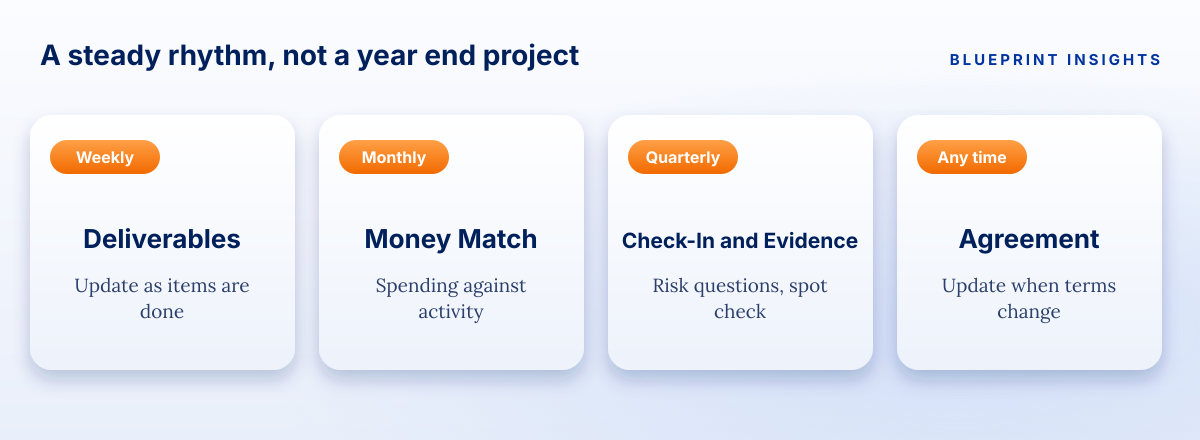
Use each checklist on a rhythm that matches how fast its information changes. The deliverables list moves weekly, spending moves monthly, risk and evidence move quarterly, and the agreement changes only when terms do.
- Weekly: Update the deliverables checklist as items are completed. Ten minutes per site is enough.
- Monthly: Run the money match for each site and note any gaps between spending and activity.
- Quarterly: Refresh the site check-in risk questions and run the evidence spot check.
- When terms change: Update the agreement checklist and tell the site the same day.
The rhythm matters more than the format. A modest checklist used every week beats an elaborate one opened twice a year.
How do you roll this out without adding burden?
Start with one program and three sites, and keep the first version small. Site teams are already stretched, so the system succeeds only if it asks little of them. Four habits keep the load light:
- Ask for the same few fields from everyone. Do not invent a new form for each site.
- Capture things once. If a site already sends a report, read the checklist data from it instead of asking again.
- Share the checklists with sites. They are most useful when everyone can see the same list.
- Keep it in one shared home. The checklists live in a single place with one structure, not scattered across inboxes and personal files.
If you are still deciding where that home should be, our article on starting with one process shows how to choose and map one process before you build.
If your oversight feeds a funder, a board, or a district report, it also helps to decide what you will measure before you launch. Our article on building impact reporting that lasts covers that step.
What if a site falls behind?
Ask early, ask kindly, and write it down. A late report is information, not an accusation. Reach out the week something slips, find out what is in the way, and offer help before you escalate. Then record what was agreed and when you will check again. Most problems that become findings began as small delays nobody mentioned.
A closing thought
Oversight does not have to feel like surveillance, and it does not have to wait for year end. Five short checklists, used on a steady rhythm, give you a record that builds as the work happens and a calm answer when someone asks how the year went.
Frequently asked questions
What is multi-site program oversight?
It is the practice of tracking commitments, spending, and evidence across several sites or regions, so leaders can see progress and catch problems early instead of at year end.
How do you track deliverables across multiple sites?
Keep one deliverables checklist in the same format for every site. Record each item as it is completed, with the date, who confirmed it, and a link to the proof.
How often should program managers review each site?
Update deliverables weekly, compare spending to activity monthly, and review risk and records quarterly. Give sites that are new, recently changed, or running late more attention.
What records should be ready for an audit or review?
Award terms, written policies, financial reports and payment records, evidence of approvals and changes, and results of earlier audits or monitoring reviews, along with what was done in response.
Do these checklists apply if we do not pass through federal funds?
Yes, as a practice. Federal rules shape some of the details, but the habits of recording work as it happens, matching spending to activity, and keeping evidence organized help any funder or program.
Note: This article shares Blueprint's perspective and general guidance for educational and illustrative purposes. Every organization, program, and regulatory environment is different, so adapt these ideas to fit your context.

Real talk on systems work
Get practical insights on automation strategy, vendor selection, and building systems ready to scale. The kind of advice that saves you thousands and six months of headaches.