79% of High Schoolers Want Work Experience. Only 2% Complete an Internship. Let's Build the Bridge.
Most high schoolers want work experience, but few complete an internship. The gap comes from late awareness, packed schedules, transportation, and limited placements. Schools, businesses, and funders can close it together with early awareness and on-site programs.


79% of High Schoolers Want Work Experience. Only 2% Complete an Internship. Let's Build the Bridge.
Student interest in career-connected learning is strong. The challenge facing school and district leaders is not a lack of commitment. It is the sheer complexity of matching student desire with relevant, practical execution. The barrier is rarely just having a static catalog of opportunities; it is ensuring that once a student steps into an experience, it feels personally meaningful, inspires genuine curiosity, and remains flexible to their real daily lives. While traditional off-site models ask schools to solve impossible scheduling and transportation puzzles, forward-thinking educators, businesses, and community leaders can partner to close the awareness gap and build accessible, future-ready career pathways.
A student walks into a counselor's office with a simple, inspiring question: How do I get real experience in a field I am curious about? The counselor wants nothing more than to say yes. But school leaders are balancing a complex matrix every day: dense academic schedules, state graduation mandates, limited district budgets, student commuting constraints, and family responsibilities after the bell. Without flexible, turn-key experiences that adapt to these realities, the conversation often ends with a hopeful "let's look into it," and the semester moves on.
That scene plays out in schools nationwide every year. It is not a motivation problem for students, nor is it an oversight by educators who work tirelessly under real constraints. The national data simply shows a massive pool of ready, curious students alongside systemic barriers that limit access. Closing this gap requires businesses, advocates, and district leaders to collaborate on new, realistic models of engagement that honor student time and potential.
What the Data Says About Student Demand
Students are actively seeking professional exposure long before graduation, but existing regional infrastructures are rarely built to absorb the demand or offer flexible engagement.
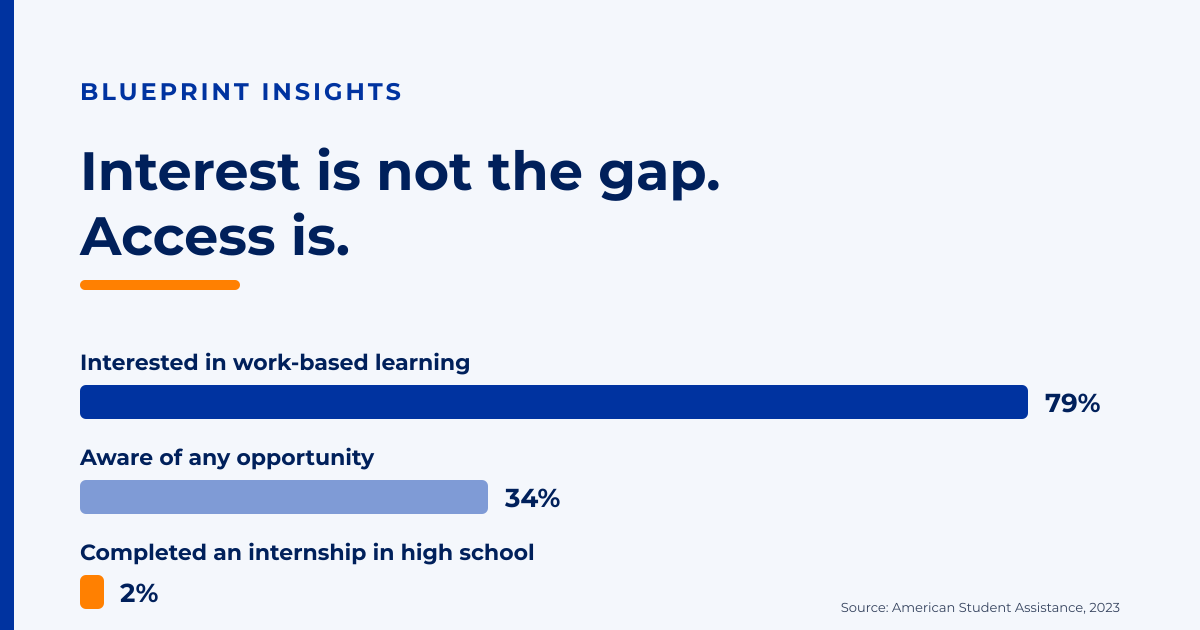
- The Awareness & Access Gap: In a 2023 national study by American Student Assistance (ASA), 79 percent of high school students said they would be interested in a work-based learning experience. However, only 34 percent were aware of opportunities for their age group, and just 2 percent had completed an internship during high school.
- Senior Year Aspirations: Research from RAND surveys published in Education Week found that 71 percent of 12th graders wanted to visit a workplace, but only 39 percent had done so. Similarly, 66 percent wanted an internship or apprenticeship, yet only 22 percent secured one.
High schools do an extraordinary job guiding students through core academic milestones, such as campus visits and financial aid applications. What the numbers show is that career-connected learning needs that same dedicated, ecosystem-wide support. Interest is already there. The opportunity lies in expanding access through relevant, student-centered pathways.
Understanding the Multi-Layered Challenge
When exploring why work-based learning remains difficult to scale, it is essential to look past simple explanations and recognize the complex realities inside school communities:
- Information Timing & Messaging: A May 2026 SRI study of Los Angeles Unified (reported by The 74) found that many freshmen learned about career pathways too late to enroll. Education Week's coverage adds that teens say their schools emphasize four-year college over other paths, which can make it harder for students exploring non-coding tech, trade, or project management paths to find timely details.
- Competing Priorities & Real-World Logistics: A high school schedule is rightly centered on graduation requirements. Expecting students to travel off-site during or after the school day introduces real hurdles, from transit costs and safety concerns to conflicts with after-school jobs, caretaking responsibilities, and extracurriculars.
- Placements are Growing, But Schools Cannot Source Them Alone: While employer participation is rising, expecting individual schools to single-handedly source, vet, and manage dozens of corporate partnerships is unsustainable. Business partners must proactively step up to meet schools halfway.
Five (5) Practical Steps Districts and Partners Can Take First
Improving access starts with low-barrier, high-impact strategies that celebrate existing efforts while streamlining how opportunities are shared:
- Introduce Pathways Early in 9th Grade: Sharing career pathway options before freshman registration allows families and counselors to align academic schedules with future hands-on learning.
- Ensure Clear, Relevant Opportunity Summaries: Providing a clear, accessible overview of active opportunities, realistic time commitments, and direct contact details helps students instantly see where they fit.
- Equip Counselors with Expanded Career Briefs: Provide guidance teams with digestible insights into modern, non-coding technology and industry roles to complement standard college application materials.
- Engage Families as Partners: Short, accessible summaries sent home help families support their student’s career curiosity past the school day.
- Track Program Awareness Annually: Measuring student awareness year-over-year helps districts understand which communication channels are working best.
These steps honor the work districts are already doing while laying the foundation for deeper, practical workplace exposure.
Rethinking Execution: On-Site & After-School Workplace Studios
To move from awareness to action without adding stress to packed school days or requiring complex student travel, the broader community must bring the workplace to the student. Merely distributing a catalog of opportunities is not enough; the experience itself must be explicitly designed to feel personally relevant, inspiring, and adaptable to student lives.
This is where on-site cohort frameworks come into play. By bringing practitioner-led projects directly into school buildings after hours, a model demonstrated by initiatives like Blueprint Workplace Studio, schools and partners can establish a practical, flexible bridge between classroom instruction and industry experience.
Operating on-site reinforces student inclusion, removes transportation barriers, and accommodates varied learning needs, all while protecting essential daytime academic blocks.
Key Components of Sustainable Program Design
Whether implemented through on-site studios or hybrid models, effective work-based learning relies on clear, collaborative, and inspiring design:
- Tangible Portfolio Deliverables: Students complete real-world deliverables, such as wireframes, workflow maps, or data dashboards, giving them concrete assets for college or job applications.
- Practitioner Mentorship: Industry professionals step in as mentors, providing students with authentic career guidance and a window into how the work gets done.
- Clear, Modern Role Exposure: Programs introduce students to modern roles in design, data, operations, and project work, helping every type of learner discover where their natural strengths fit.
When these parameters are clearly established, school teams can easily introduce the program to students in just a couple of minutes.
Measuring Meaningful Progress
Schools and their industry partners can track progress by looking at three connected metrics over time:
Student Interest → Program Awareness → Active Participation
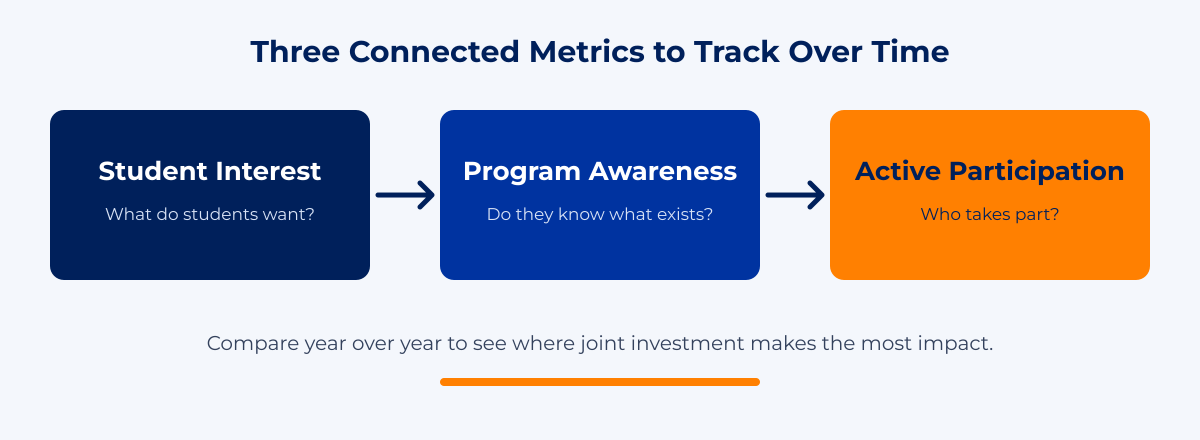
When awareness increases in a supportive, inspiring environment, participation has room to follow. Tracking this progress gives education and business leaders clear visibility into where joint investments are making the greatest impact.
A Call to Action for Business Leaders and Education Advocates
Students are asking for experience, and school leaders are working hard to provide holistic support. The responsibility now falls on the broader business ecosystem, philanthropies, and edtech leaders to collaborate with schools by offering flexible, turn-key solutions that fit the real lives of today's students and help them graduate future-ready.
Interest is already established. By building realistic, supportive bridges together, we can ensure every student gets the opportunity to thrive.
To explore how host cohorts operate in New York City schools or learn more about building work-based learning bridges, explore the Blueprint Workplace Studio overview or reach out to team@blueprintco.org.
Frequently Asked Questions
How many high school students want work-based learning? ASA research shows that 79 percent of high school students are interested in work-based learning, and RAND data notes that 66 percent of 12th graders specifically desire internship or apprenticeship opportunities.
Why are internship completion rates currently low? In our view, the 2% completion rate reflects complex realities, including late student awareness, packed daytime schedules, off-site transit barriers, family and job responsibilities after school, and limited employer placement capacity.
What is an easy first step for district teams to increase awareness? Publishing a centralized, plain-language directory of all available career pathways during freshman year helps students and families plan early.
How can businesses and advocates help schools offer future-ready, career-connected learning without adding logistical friction? By partnering on turn-key, on-site after-school models, such as Blueprint Workplace Studio, where industry practitioners bring real-world projects directly into school buildings, removing travel hurdles while honoring daytime academic priorities and student flexibility.
Note: This article shares Blueprint's collaborative perspective and general guidance for educational and illustrative purposes. Every school community has unique strengths and realities, and we encourage adapting these ideas to serve local needs best.

Real talk on systems work
Get practical insights on automation strategy, vendor selection, and building systems ready to scale. The kind of advice that saves you thousands and six months of headaches.